One step. One cue. One moment.
Last week we slowed down. This week we simplify. Because even at the right pace, too much at once still overwhelms.
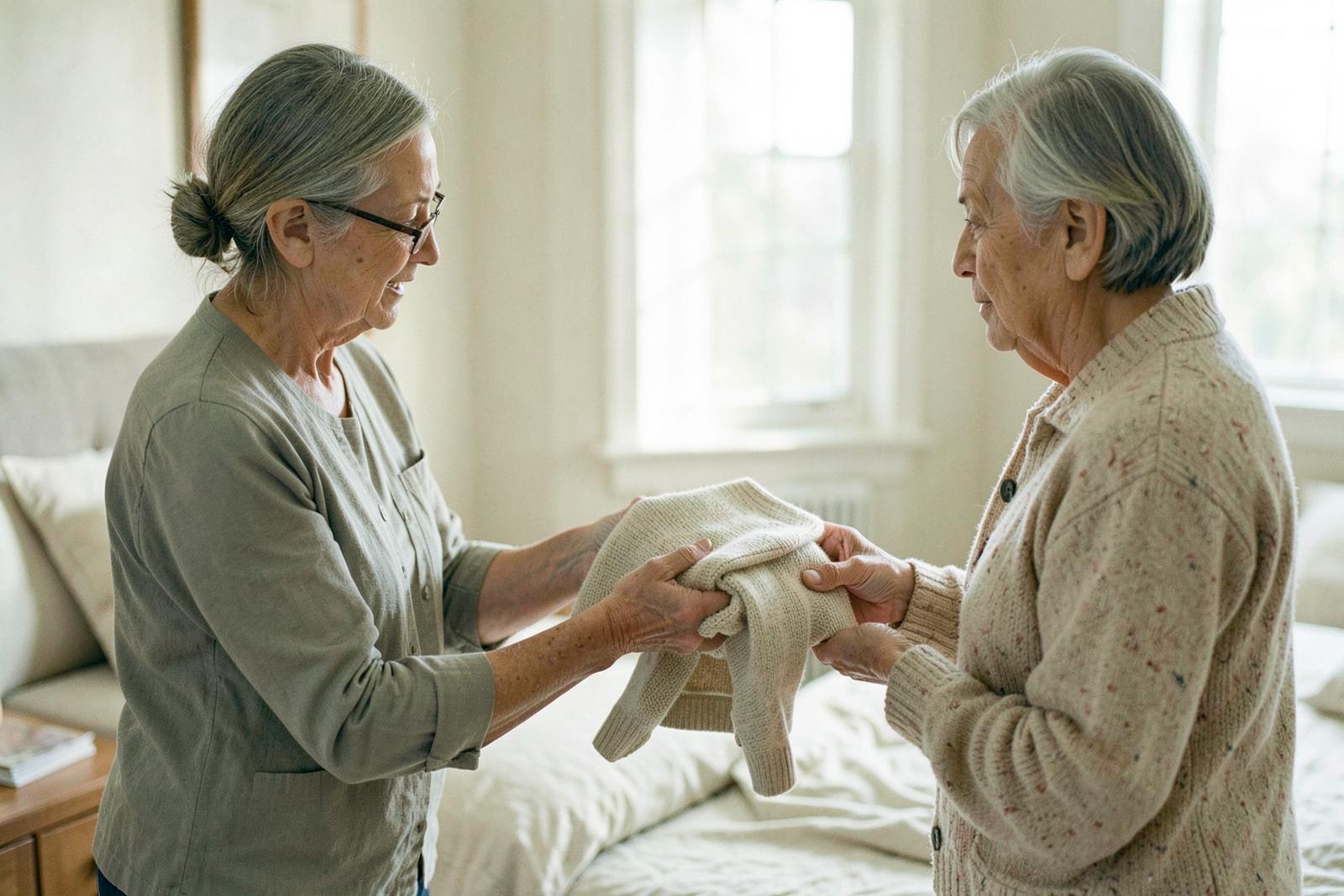
The teaching
Most everyday tasks are chains of small decisions we no longer notice: get up, walk to the closet, choose a shirt, put an arm through, then the other, then the buttons. A brain living with dementia experiences each link in that chain as its own task. When we hand over the whole chain at once, we are not asking for one thing — we are asking for twenty.
Simplifying is not doing everything for the person. It is breaking the moment into pieces small enough to succeed at, then staying present through each one. Success builds on success. Overwhelm does the opposite.
Give them the next step, not the whole staircase.
How to simplify the moment
One step at a time
Break every task into single actions. “Put your arm in the sleeve.” Wait. Then the next. Never the whole sequence at once.
One cue at a time
Use one short phrase, then point, gesture, or hand them the item. Words plus a visual anchor travel further than words alone.
Reduce the choices
Two shirts, not a full closet. Tea or coffee, not “what would you like to drink?” Fewer options mean more answering, not less dignity.
Set up the win
Lay out items in the order they're used. Hand over the toothbrush with paste already on it. Remove the steps you can so they can keep the ones they still own.
When the whole task is too much
“Go get dressed and come down for breakfast.”
“Here's your shirt. Put your arm in this sleeve.”
“What do you want to wear today?”
“The blue one or the green one?”
“Brush your teeth, wash your face, and comb your hair.”
“Here's your toothbrush.” (then, when done) “Now the washcloth.”
“Just do it the way I showed you.”
“Let's do the first part together.”
Real-world example: the coat by the door
A family was certain their father could no longer dress himself to go out. He would stand by the door in his indoor clothes, coat in hand, doing nothing. They had started dressing him entirely, and he had started resisting.
A consultant suggested handing him one piece at a time, in order, with a simple cue: “Arms in.” (pause) “Now the zipper.” He did every step himself. The ability was never gone — the sequence was. Given one cue at a time, he found his way through all of them.
Phrase of the week
“Here's your shirt.”
“One arm, then the other.”
“Let's just do this one part.”
Caregiver reflection
Which daily task could I break into single steps — and what might my person still be able to do if I did?
One honest caveat
Simplifying can slide into doing everything for them, which quietly takes abilities away faster than the disease does. Offer the step, then wait. If they can do it, let them — even slowly, even imperfectly. The goal is participation, not perfection.
Next week: don't test memory — support it. Until then, with care — Bella