Don't test memory — support it.
Memory loss already asks a person to navigate uncertainty all day. Our job is not to find out what they can still recall — it is to give them enough support to stay confident, connected, and involved.
The teaching
We test memory more often than we realize. “Do you remember who this is?” “What did you have for breakfast?” “I just told you — where are we going?” These can sound like ordinary conversation, but to a person living with dementia they may feel like questions with one right answer and an audience waiting for it.
When the answer does not come, the person may feel exposed, anxious, or ashamed. Repeated failure can lead them to withdraw or cover the gap with humor, guessing, anger, or silence. None of that tells us what they truly understand. It tells us the moment no longer feels safe.
Don't ask the brain to prove what it remembers. Give it what it needs to participate.
How to support memory without testing it
Give the answer first
Introduce people and plans naturally: “It's your granddaughter Maya” or “We're going to the doctor after lunch.” Information is support, not cheating.
Use visible cues
A labeled photo, a note by the door, or clothes laid out in order can carry information without calling attention to what has been forgotten.
Offer recognition, not recall
Instead of an open question, offer two familiar choices or share a detail they can respond to. Recognition often remains available after recall becomes difficult.
Repeat without keeping score
Answer the question as if it is the first time. For them, it may be. Your steady tone matters more than whether the words have been said before.
Turn the quiz into a cue
“Do you remember who I am?”
“Hi, Mom — it's Bella. I'm so happy to see you.”
“What did you do this morning?”
“I heard you spent time in the garden this morning. How did it feel outside?”
“You know where we're going, right?”
“We're going to your appointment, and I'll be with you the whole time.”
“What is her name?”
“Here's your neighbor, Rosa. She brought those flowers you like.”
Real-world example: the family photo
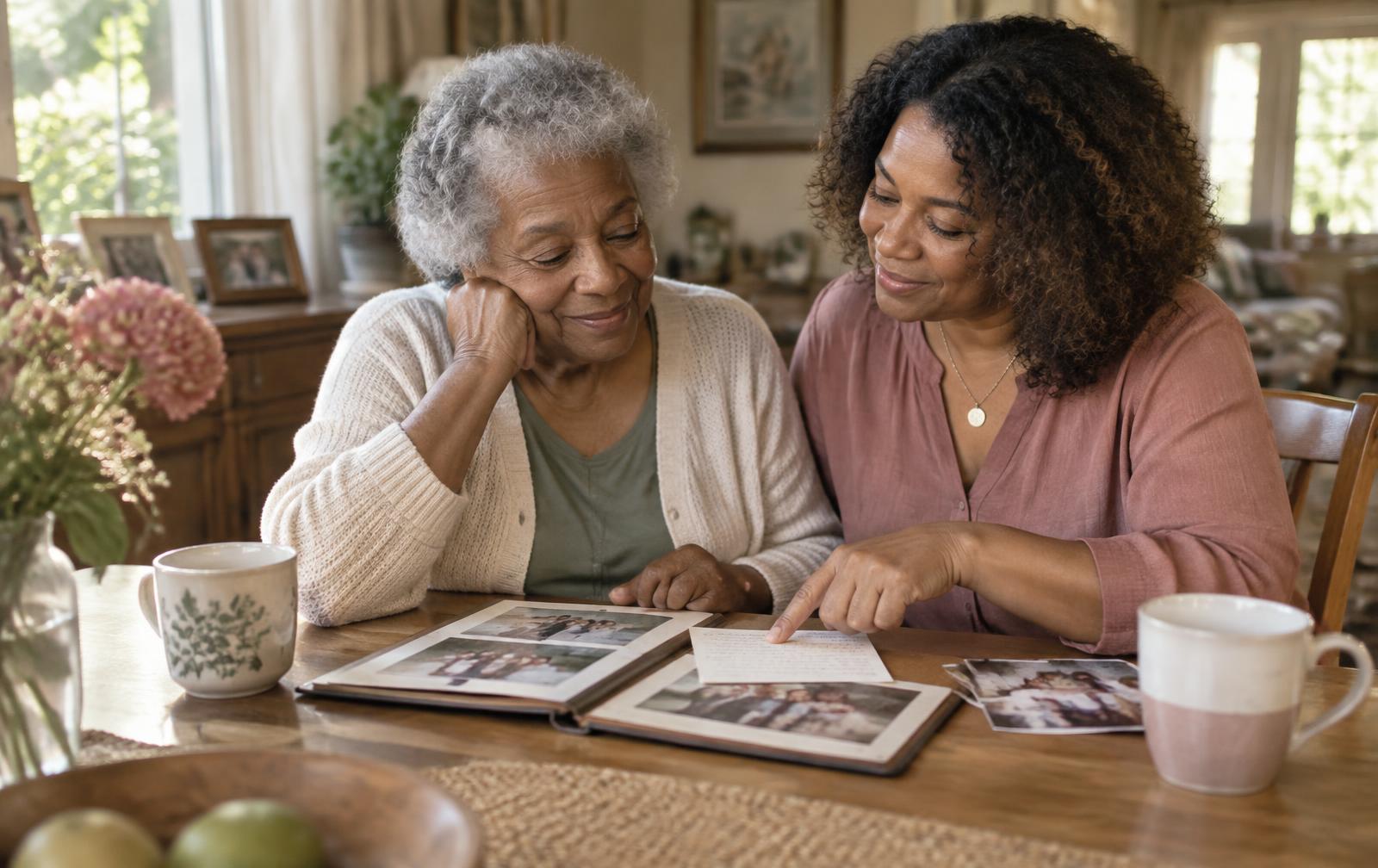
A daughter opened an old album with her father and pointed to a wedding picture. She almost asked, “Do you remember this day?” Instead, she said, “This is the day you and Mom were married. Look at that smile.”
He did not name the year or the place. He looked at the photograph and said, “She was beautiful.” The memory did not need to be complete to be meaningful. By offering the context first, his daughter made room for connection instead of a correct answer.
Phrase of the week
“It's Bella — I'm glad to see you.”
“Here's what we're doing next.”
“I'll remind you whenever you need me to.”
Caregiver reflection
Am I inviting this person into the moment — or asking them to prove they belong in it?
One honest caveat
Supporting memory does not mean never asking a question. Questions about comfort, preferences, pain, and consent still matter. Keep them simple, give time to answer, and never assume silence means agreement. The difference is purpose: ask to understand the person, not to measure what they have lost.
Next week: preserve dignity, even when ability changes. Until then, with care — Bella